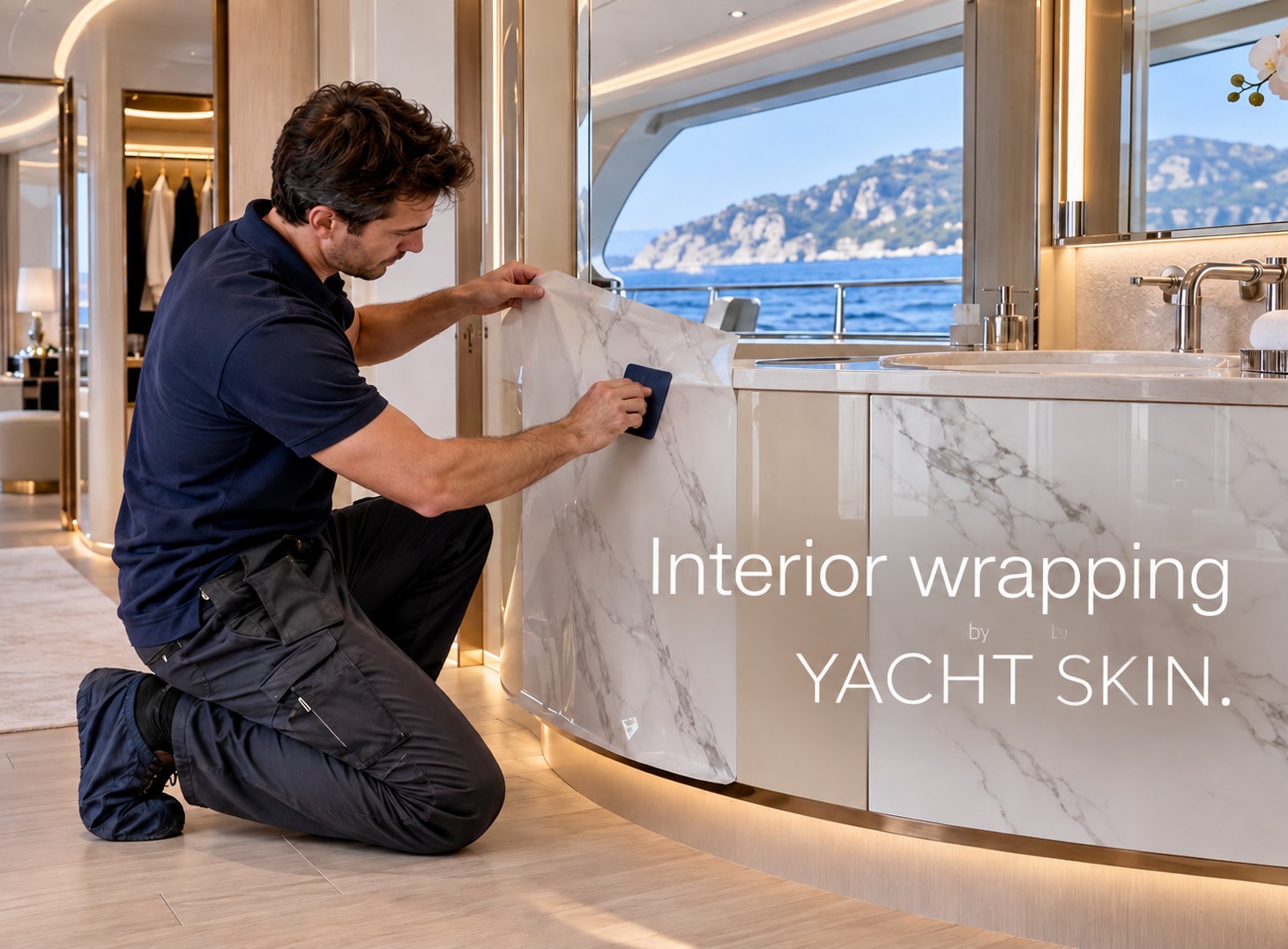
Protection. Transformation. Preservation.
Wrapping is an intelligent and environmentally responsible solution that can significantly reduce
costs, materials and waste compared with traditional refurbishment. It combines premium aesthetics,
durability, speed and flexibility, while minimising the use of chemicals and avoiding the unnecessary
removal and replacement of existing surfaces.
Protection & Wrapping in the Yacht Industry
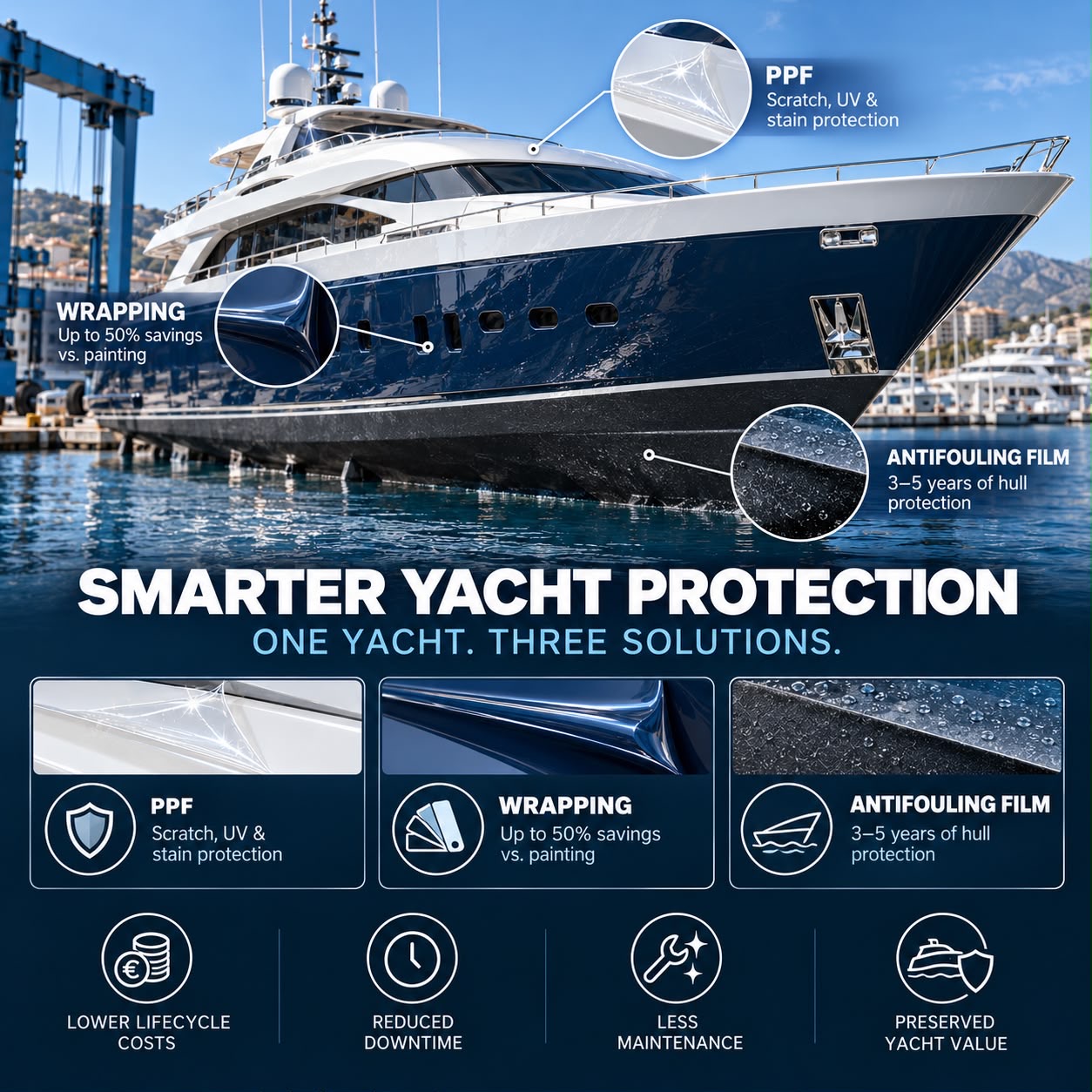
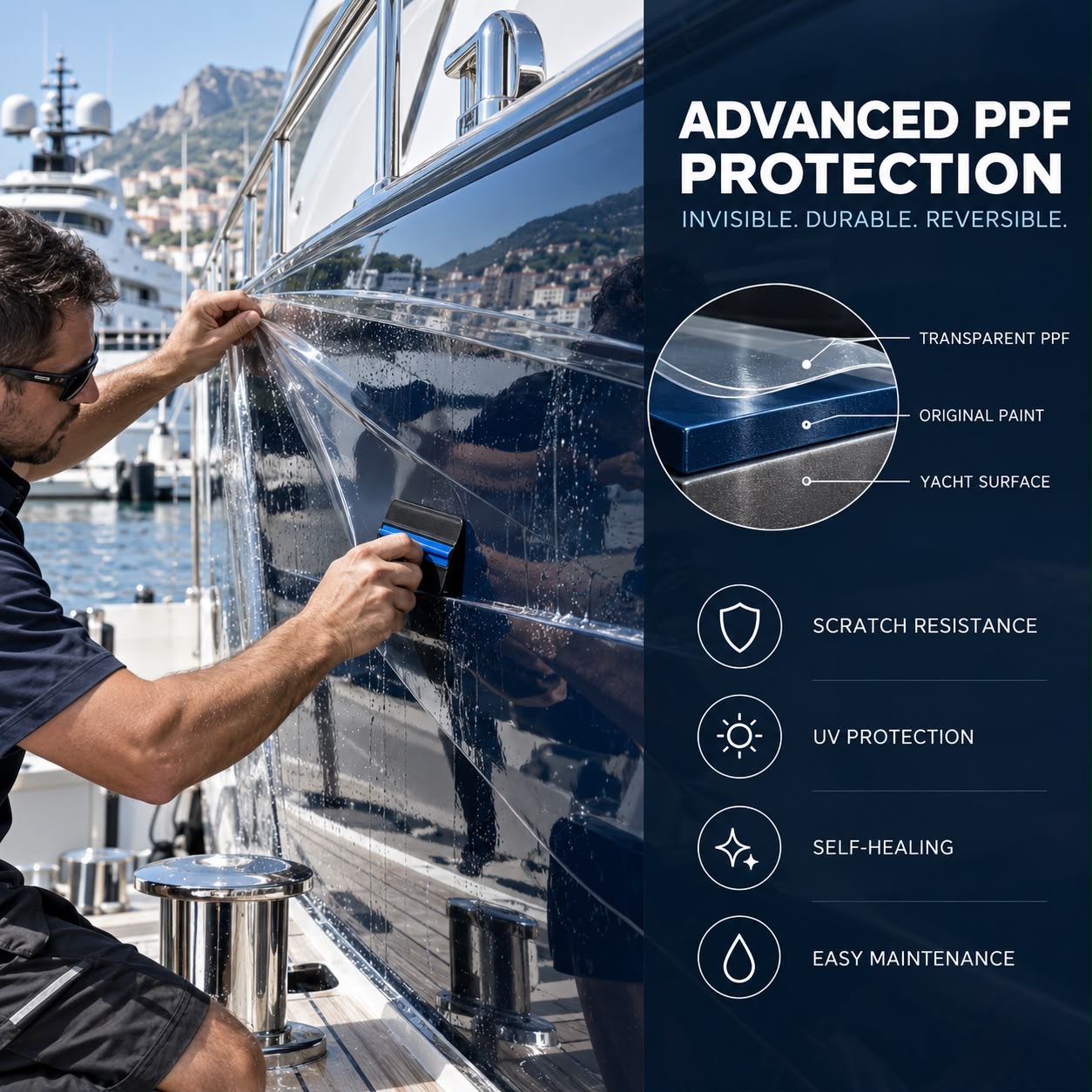
For years, the conversation surrounding protective films in yachting has largely borrowed its terminology from the automotive world, most notably PPF, or Paint Protection Film.
There is, however, a fundamental limitation to that terminology: a yacht is far more than a collection of painted surfaces.
Walk around any modern yacht and the extraordinary diversity of materials immediately becomes apparent. Painted aluminium may sit alongside gelcoat, carbon-fibre composites, glass, polished surfaces, high-gloss interior finishes and an extensive range of specialist decorative materials. On larger yachts, this complexity increases considerably.
Yet protective films are still often discussed as though a single substrate, a single product category and a single application philosophy could adequately address them all.
They cannot.
Perhaps the time has therefore come for the marine industry to look beyond the concept of paint protection and embrace a broader and more relevant approach: surface protection.
From PPF to SPF
Paint Protection Film remains an entirely appropriate term when paint is precisely what is being protected. Within the marine environment, however, a more comprehensive category may be Surface Protection Film, SPF.
This distinction goes beyond semantics.
Terminology influences the way we understand and position a technology. When a captain, owner, shipyard or yacht manager hears “PPF”, the immediate assumption is often that the discussion concerns painted topsides or another coated exterior surface.
Yet this overlooks a far more important question:
Which surfaces aboard a yacht could benefit from being protected before repair, restoration or replacement becomes necessary?
That question shifts the focus away from the product itself and towards the surface it is intended to preserve.
And that is where the conversation becomes considerably more interesting.
Start With the Substrate, Not the Film
A professional surface-protection strategy should begin with three fundamental questions:
What is the substrate? What condition is it in? And what stresses will that surface encounter during the yacht’s actual operation?
Only once those questions have been answered should material selection begin.
A painted surface regularly exposed to fenders presents an entirely different challenge from gelcoat subjected continuously to UV radiation and saltwater. A high-gloss interior panel touched dozens of times each day requires a different approach from a carbon-fibre component installed in an exterior environment.
Installation methodology, adhesive behaviour, surface preparation, removability and anticipated service life may all vary considerably.
This is precisely why the marine sector should resist simply transferring automotive processes directly onto yachts.
A yacht is not a large car.
Its substrates, environment, operational cycles, accessibility requirements and maintenance regimes are fundamentally different.
Protection Before Correction
Much of yacht maintenance remains inherently reactive.
A surface is exposed. Over time, it becomes scratched, weathered or damaged. It is then cleaned more aggressively, polished, repaired or ultimately refinished.
There is nothing inherently wrong with these processes. Paintwork, gelcoat repair and traditional refinishing will remain essential elements of yacht maintenance.
But perhaps another question should be asked much earlier:
Could the original surface be preserved before corrective intervention becomes necessary?
This is the principle behind a sacrificial protective layer.
Rather than allowing operational wear to act directly upon a valuable underlying finish, an appropriately specified protective layer absorbs a significant proportion of that exposure.
Should a localised area become damaged, the maintenance decision may consequently shift from refinishing a substantial section of the original surface to replacing a precisely defined section of protective film.
The implications extend far beyond aesthetics.
Downtime Must Be Part of the Equation
Surface treatments are frequently compared according to their initial project cost. While understandable, this provides only part of the economic picture.
Particularly on larger yachts, the true calculation should also consider shipyard time, access systems, surface preparation, dismantling, crew coordination, future repairability, ongoing maintenance requirements and operational downtime.
A treatment with a lower initial cost does not necessarily represent the lowest cost over its entire lifecycle.
Conversely, a more substantial investment in protection may prove economically compelling if it preserves an expensive underlying finish, facilitates localised repairs or prevents more extensive corrective work in the future.
The relevant question should therefore not simply be:
“What does this treatment cost?”
It should be:
“What will this surface cost to maintain throughout its useful life?”
That represents a far more sophisticated approach to evaluating refit and maintenance decisions.
If surface protection delivers a measurable benefit, we should be able to demonstrate it. If it does not, we should understand that too.
That is the level of evidence the industry increasingly requires.
The Maintenance Question We Have Yet to Quantify Properly
There is another area deserving considerably greater attention.
Anyone familiar with professionally maintained yachts understands the extraordinary level of effort required to keep their surfaces to the expected standard: water, cleaning products, labour, polishing and repeated corrective treatments.
None of this suggests that these procedures are unnecessary. The standards expected aboard a superyacht are exceptionally high.
But it does raise an important question:
If the original surface is properly protected, could it subsequently be maintained using less aggressive cleaning chemistry, fewer polishing cycles and fewer corrective interventions?
The marine industry should not attempt to answer this question through marketing claims alone.
It should answer it with data.
Protected and unprotected areas can be compared. Water consumption can be measured. Cleaning products and chemical usage can be documented. Labour hours, polishing intervals, repairs and surface condition can all be monitored over time.
If protection produces measurable improvements, those improvements should be demonstrable and quantifiable.
This is the kind of evidence that can transform surface protection from a product proposition into a genuine maintenance strategy.
From Installation to Lifecycle Management
This philosophy also changes what a professional surface-protection company should ultimately provide.
Installing a material and leaving the vessel should not necessarily mark the end of the relationship.
Imagine instead creating a digital surface record for the yacht.
Which areas have been protected? What is the underlying substrate? Which material was installed, and when? Which production batch was used? Where have repairs been carried out? How has the protected surface aged? When should it next be inspected or replaced? Which maintenance programme has been followed?
Over time, this becomes far more valuable than a simple installation record.
It creates a genuine surface lifecycle history.
For yacht managers, shipyards, captains and ultimately owners, such information could make future maintenance and refit decisions considerably more predictable, transparent and cost-efficient.
At YACHT SKIN, we are developing this philosophy towards a broader concept of Surface Lifecycle Management, combining substrate-specific protection strategies with documentation, inspection, maintenance and localised repair throughout the lifetime of the installation.
Refit Should Become More Preventive
The superyacht industry has become extraordinarily sophisticated in many areas.
Engines, machinery, navigation systems and technical equipment are continuously monitored because preventive maintenance is recognised as preferable to waiting for failure.
Yet some of a yacht’s most visible, valuable and expensive surfaces are still managed largely through corrective intervention.
Perhaps surface management deserves the same evolution in thinking:
Assess. Protect where appropriate. Monitor. Maintain.
Repair locally whenever possible. Replace the protective layer when necessary. Preserve the valuable original surface beneath it.
This approach will not necessarily be appropriate for every surface, every yacht or every operational environment.
And that is precisely the point.
Surface protection should not begin with a roll of film. It should begin with an understanding of the surface.
The yacht of the future will not rely upon a single “surface solution”.
It will have a surface strategy.
Beyond Paint
PPF will continue to play an important role within yachting.
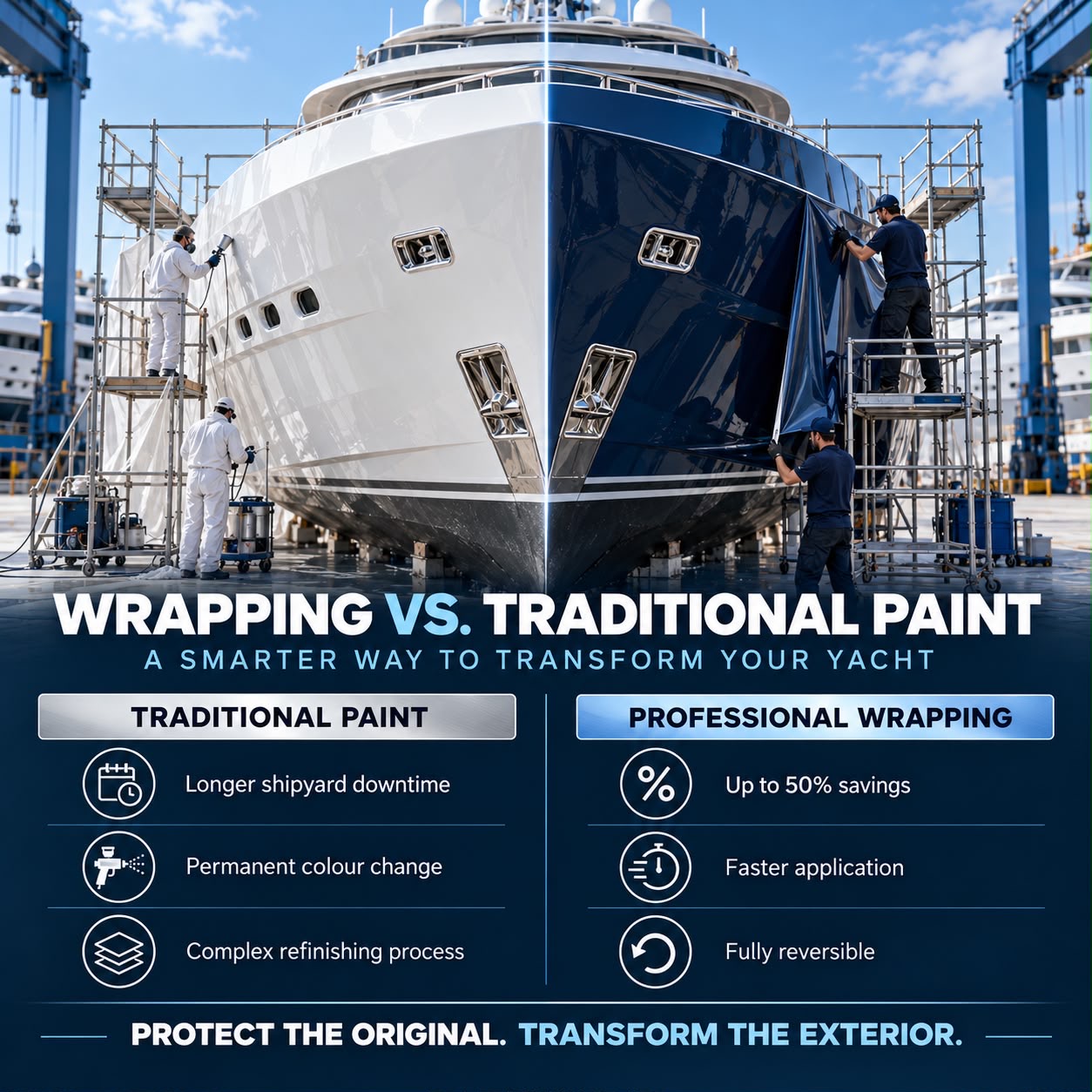
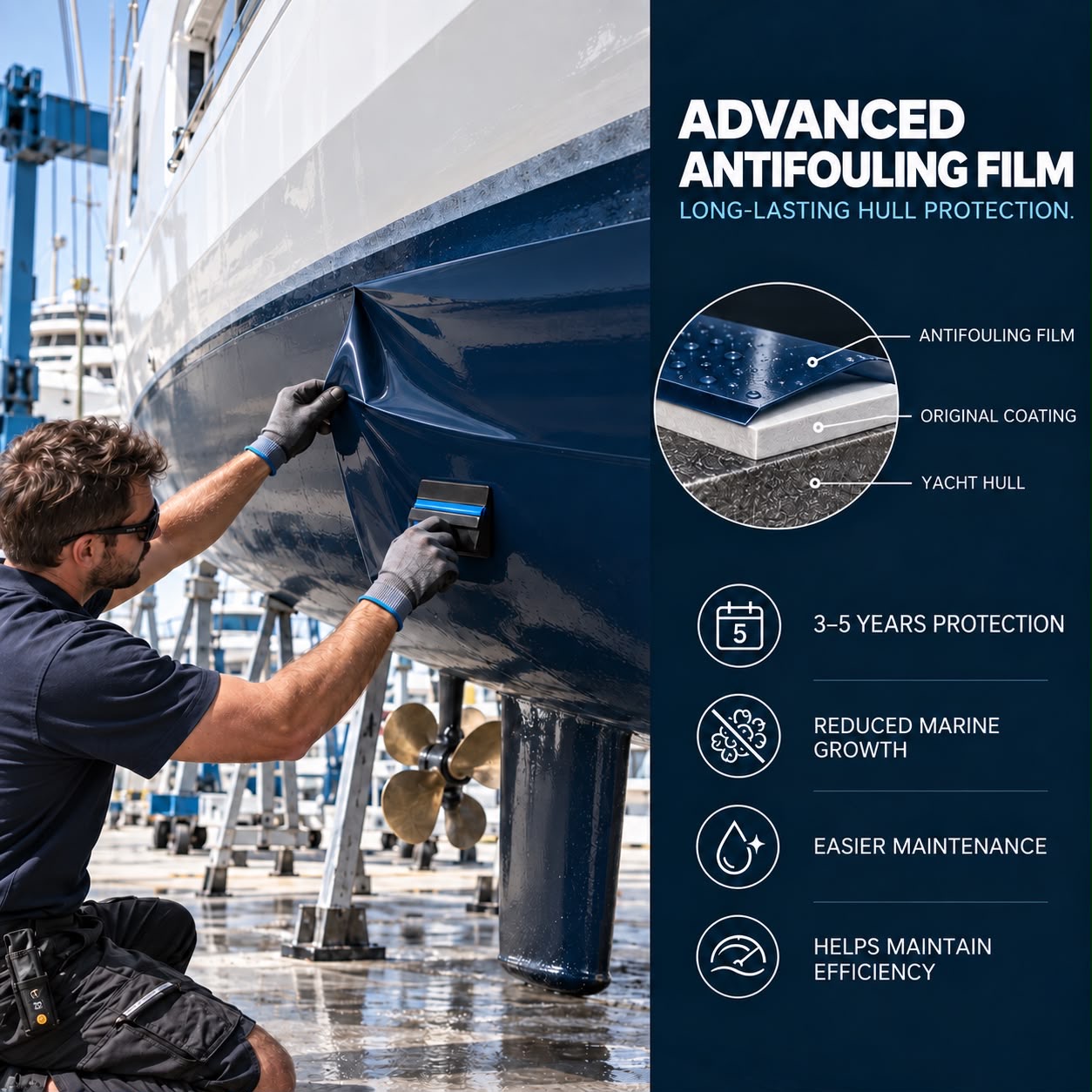
Vinyl will remain an exceptionally effective solution for reversible colour, aesthetic and design transformation. Advanced coatings will continue to serve specific applications, while traditional paint systems and refinishing will remain indispensable.
The opportunity lies not in positioning these technologies as competitors, but in understanding how they can complement one another as part of an integrated surface strategy.
As refit becomes increasingly focused on efficiency, reduced downtime, preservation, lifecycle value and measurable environmental performance, this approach is likely to become an increasingly important part of how yachts are maintained and managed.
Perhaps the next significant development in yacht surfaces will therefore not be another finish, coating or material.
It will be learning how to protect, preserve and intelligently manage what is already there.
Yacht Skin
Protection. Transformation. Preservation.